
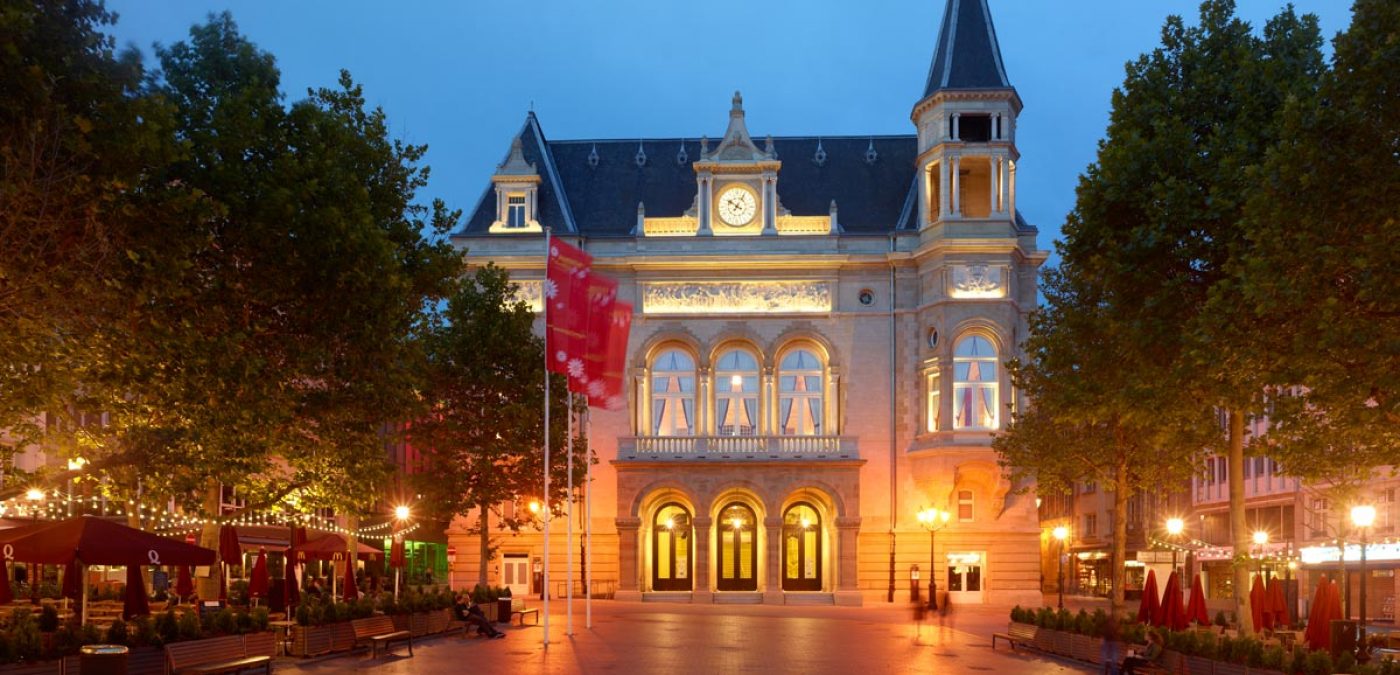
Luxembourg, Luxembourg
Registration Year
Registered Sector
Historical Function
Administrative Status
Mayor of Luxembourg

Xavier Bettel
Links
Location and site
Historical Reference
- A castle stronghold erected by the Count Sigefroid on the Rocher du Bock dates to the origin of the city in 963. In the later years of the Roman Empire (late 4th century and early 5th century), a fortification occupied this same site, which was close to the intersection of two Roman roads.
- Urban expansion necessitated the construction of a second fortification wall at the end of the 12th century. A third wall, known as the Wenceslas Wall, was erected in the 15th century to integrate the Plateau du Rham and, in the lower town, the Grund quarter.
- The fortress of Luxembourg was coveted. After it was incorporated into the Circle of Burgundy of Charles-Quint during the 16th century, the country was involved in conflicts involving, among others, the House of Burgundy, the House of Habsburg, Napoleon III and Bismark's Prussia.
- Under its foreign rulers, the defense system of the city was reinforced and developed in four stages. The Spanish (1671-1684), the French under the direction of Vauban (1684-1697), the Austrians (1715-1795), and the Prussian garrison as part of the German Confederation (1815-1867) participated in the creation of this fortified ensemble.
- In 1867, the signing of the Treaty of London led to the stipulation that the Grand Duchy would remain neutral in perpetuity. Shortly afterwards, the fortress was evacuated and the defense system was for the most part dismantled. The extent of the fortifications had reached 180 hectares, and the city was 120 hectares in area.
Urban Morphology
The site includes the upper city and the lower city which developed around the deep valley of the Alzette and Pétrusse rivers. The Chemin de la Corniche follows the edge of the escarpment, overlooking the meandering river that dictated the layout of adjacent roads. Bridges and viaducts straddle the valley, linking different parts of the city. The network of roads, which was influenced by military planning, has been preserved. Numerous views may be enjoyed from the valley and the upper parts of the city.
Within this uniform urban ensemble, the military architecture which remains - bastions, towers, barracks, forts, and vestiges of locks - still evokes the force of the site over the course of its history. Linked to the natural landscape, the rich architectural panorama of Luxembourg is dominated by the 17th-century Church of St-Michel and the spires of the 17th-century cathedral of late Gothic expression. On the Chemin de la Corniche, as in the valley, the houses line the curve of the river.
Registration Criteria
"The fortress city of Luxembourg played a significant role in the history of Europe for several centuries. It preserves major remains of its impressive fortifications and its old quarters, in an exceptional natural setting." (IV)
Contact
| Monsieur Xavier Bettel Député-Maire | Hôtel de ville 42, place Guillaume II Luxembourg, Grand Duché du Luxembourg | Tel: +352 4796.2674 Fax: +352 22 74 99 Email: bettel@vdl.lu |
| Monsieur Patrick Sanavia Directeur | Service des Sites et Monuments Nationaux 26, rue Münster Luxembourg, Grand Duché de Luxembourg | Tel: +352 247 86650 Fax: +352 46 17 79 Email: patrick.sanavia@ssmn.etat.lu |
| Madame Martine Vermast Architecte-directeur | Administration communale 3, rue du Laboratoire Luxembourg, Grand Duché de Luxembourg | Tel: +352 47962850 Fax: +352 4796 4789 Email: mvermast@vdl.lu |


